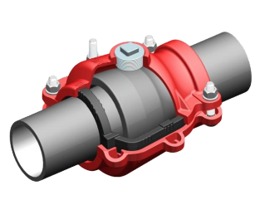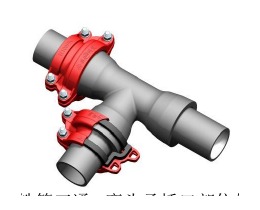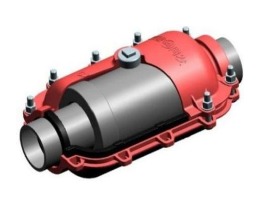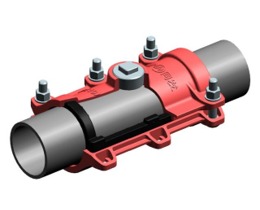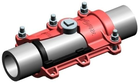
A repair clamp that seals a ductile iron (DI) main will leak within weeks on a polyethylene (PE) line of the same nominal diameter. The pipes measure alike on a caliper, but they fail in completely different ways — and the clamp has to be engineered for the pipe’s failure mode, not just its outer diameter.
This post walks through the four material families you’ll repair most often and explains why each needs a purpose-built clamp.
1. Ductile iron (DI) and grey cast iron
Behavior under clamp: rigid. DI and grey iron don’t deform under the torque a repair clamp applies. Wall thickness is typically 7 mm for DN100 and up, so ovality under load is negligible.
Dominant failure mode: leaks at socket joints (bell-and-spigot), cracks at straight-pipe sections from pressure surge or ground settlement.
Clamp requirements:
- Rigid cast body — usually QT450-10 ductile iron — to match the pipe’s stiffness
- Narrower gasket (the pipe surface is smooth and consistent)
- Standard 1.0 MPa or high-config 1.6 MPa pressure rating
- Socket repair clamp for bell joints, straight-pipe clamp for mid-section cracks, sleeve clamp for sleeve joints
Gotcha: grey cast iron (older pipe, pre-1970s in most jurisdictions) is brittle. Over-torqueing a clamp can crack the pipe. Use a torque wrench and stop at the bolt spec — don’t “just give it a bit more.”
2. Steel pipe and galvanized steel
Behavior under clamp: rigid, but thinner-walled than DI. Commercial galvanized pipe in the DN15–DN100 range (utility mains, indoor gas distribution) has walls 2–4 mm thick.
Dominant failure mode: corrosion pinholes at thread joints (galvanized), weld seam leaks (carbon steel), external corrosion near soil line.
Clamp requirements:
- Lower bolt torque than DI — excessive clamp pressure flattens thin-wall pipe, which makes the seal worse
- Longer seal contact patch to bridge pinhole clusters
- NBR gasket for gas-distribution galvanized pipe (not EPDM — see our post on gas compatibility)
- Specific variants for tees, elbows, and unions — fittings are the most common leak point on threaded galv, not straight pipe
PipeKnot makes dedicated galvanized steel pipe clamps, plus union, tee, and elbow repair clamps for threaded-joint leaks.
For heavy-wall welded steel mains (DN125 and up), use the straight-pipe steel clamp rated to 1.6 MPa.
3. PE, PVC, and PPR plastic pipes
Behavior under clamp: plastic pipes creep — they slowly deform under sustained load. A clamp that seals perfectly at installation can leak 6 months later as the pipe wall relaxes under the gasket.
Dominant failure mode: split along fusion lines, crushed by external load, UV embrittlement near exposed sections, chemical attack on PVC.
Clamp requirements:
- Wider gasket contact area than metal-pipe clamps — the larger footprint distributes seal pressure and maintains contact as the pipe creeps
- Lower clamp torque — typically 60–70% of metal-pipe torque
- Larger inner diameter allowance — plastic pipe OD varies widely between standards (ISO 4427 PE vs. GB PE vs. imperial PVC). A 110 mm “DN100” PE and a 114 mm “DN100” PE are not interchangeable. Always measure.
- For sustained pressure service, look for ISO 17885 certification
PipeKnot’s plastic-pipe range covers socket, straight, sleeve, and reverse variants, plus specialized equal tee and reducing tee clamps for branch repairs.
For PE-specific fusion joint leaks, use the direct PE repair clamp — designed to accommodate the bead at the weld line.
4. Concrete pipe (self-stressed and pre-stressed)
Behavior under clamp: concrete pipe has a rough, uneven outer surface — you can’t get a mirror-smooth seal against it. Also, the pipe wall is thick (often 50–80 mm) and has steel reinforcement inside.
Dominant failure mode: gasket failure at spigot joints, cracks from freeze-thaw or soil pressure, corroded prestressing wire (hard to detect until catastrophic).
Clamp requirements:
- Thicker, softer gasket — bridges surface irregularities (typical shore hardness 50–60A, vs. 70A for DI clamps)
- Longer clamp length — distributes load across more pipe surface so pinpoint pressure doesn’t crack the concrete
- Inner diameter range that accommodates concrete-pipe OD tolerance (typically ±5 mm vs. ±2 mm for DI)
PipeKnot’s concrete pipe range: socket repair clamp for spigot joints, straight-pipe clamp for mid-section cracks, and the concrete pipe haff saddle clamp for branch connections.
What happens when you pick the wrong clamp
| Scenario | What happens |
|---|---|
| DI clamp on PE pipe | Seals at install, leaks within weeks as PE creeps away from the narrow gasket |
| PE clamp on DI pipe | Won’t hit the torque spec — the soft gasket oversqueezes and extrudes |
| Concrete clamp on steel pipe | Thick gasket over-compresses; not enough bolt travel to achieve rated seal |
| Generic “universal” clamp on concrete | Gasket doesn’t bridge surface roughness; drips within hours |
The “universal” clamp in the last row is the one that tempts panicked field crews. Don’t use them for permanent repairs on concrete or plastic.
Fast decision tree
- What material? Caliper the pipe and identify by eye (DI is grey and magnetic; steel is grey, magnetic, often coated; PE is black with blue stripe; PVC is white or blue; concrete is grey and rough).
- Where is the leak? Joint type drives clamp geometry (socket / straight / sleeve / flange / tee).
- What’s the operating pressure and fluid? Pressure sets the MPa rating; fluid sets the gasket (water → EPDM; gas → NBR; industrial → check chemical compatibility).
- Measure the OD, not the DN. Match the clamp to actual outer diameter.
If any of these four answers is uncertain, call us. We’d rather answer a 10-minute phone call than ship a clamp that fails in the field. Contact PipeKnot.