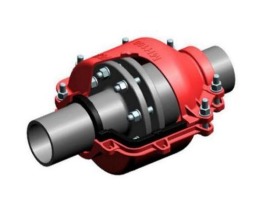
If you’re repairing a natural gas line with a clamp that has an EPDM gasket, you’re running two simultaneous problems: the seal will degrade faster than expected, and in most jurisdictions you’re in violation of the pipeline safety code. This post explains why — and what to specify instead.
The chemistry in one paragraph
Natural gas is a mixture of hydrocarbons, primarily methane, with trace amounts of ethane, propane, and heavier fractions. Hydrocarbons dissolve into and swell most rubbers. EPDM (ethylene propylene diene monomer) swells significantly in hydrocarbon service — the rubber absorbs the gas, grows in volume, loses its compression set, and eventually extrudes out from between the clamp surfaces. NBR (nitrile butadiene rubber, also called Buna-N) is specifically formulated with acrylonitrile content that resists hydrocarbon absorption. It was developed in the 1930s for exactly this kind of service.
This isn’t a subtle effect. EPDM in gas service typically shows visible swelling and hardness drop within weeks; NBR is stable for years.
What the regulations actually say
In the United States, 49 CFR Part 192 — “Transportation of Natural and Other Gas by Pipeline: Minimum Federal Safety Standards” — is the governing regulation. The sealing-material requirement is not a single numeric line; rather, §192.55 through §192.65 require materials be “qualified” for the service, which in practice means demonstrating chemical compatibility through standardized tests or manufacturer certification.
Every gas utility and every municipal code we’ve seen interprets this as: use NBR (or a superior hydrocarbon-resistant elastomer like FKM/Viton) for natural gas service. EPDM is explicitly excluded on material data sheets from essentially every major clamp manufacturer for gas service.
In China, the equivalent is GB/T 21446 and the pipeline gas safety regulations under GB 50028. Similar rule: NBR or FKM for fuel gas.
In Europe, EN 549 classifies elastomers for gas service and explicitly lists compatible nitrile grades.
The temperature angle
Another reason NBR wins on gas lines: the service temperature window. Typical gas distribution operates between −20°C and +60°C at the pipeline. NBR handles this easily. EPDM handles higher temperatures than NBR in absolute terms (EPDM up to ~150°C for water/steam service vs. NBR to ~100°C), but that advantage doesn’t matter here — gas lines don’t run hot.
If you’re repairing a high-temp industrial gas line (syngas, heated LPG vapor), you may need FKM (Viton) — it handles hydrocarbon exposure and temperatures up to 200°C. That’s a specialty product, not a standard stock item.
What “gas-compatible clamp” should actually look like
When you order a clamp for gas service, the material spec should explicitly list:
- Gasket material: NBR (nitrile), Shore A hardness 70 ±5, oil-resistant grade
- Body: QT450-10 ductile iron or stainless steel, depending on corrosivity
- Bolting: 304 or 316 stainless steel (carbon steel bolting in corrosive gas-utility trenches fails faster than you’d expect)
- Coating: fusion-bonded epoxy (FBE) minimum 250 µm for underground installation
If the quote doesn’t specify gasket material — ask. If the supplier says “standard rubber” or “EPDM available,” that’s a red flag for gas service.
PipeKnot’s gas-line products
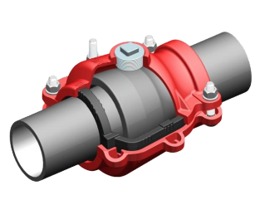
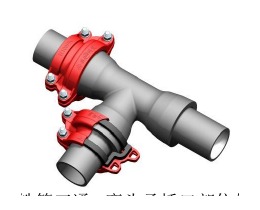
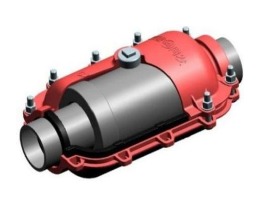
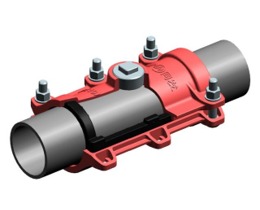
PipeKnot stocks dedicated gas-service clamps with NBR gaskets for the most common fault points on galvanized-steel distribution systems:
- Union repair clamp — for the threaded unions that are the #1 leak point on older galv systems
- Tee repair clamp — for branch-tee leaks
- Elbow repair clamp — 45° and 90° elbow fittings
- Union haff clamp — heavier-duty alternative for union joints under higher pressure
- Galvanized steel straight repair clamp — straight-pipe section repair
All ship with NBR gasket as standard when the product is specified for gas service. The shell is QT450-10 ductile iron; bolting is 304 stainless.
Common mistakes we see on gas-line repair orders
- Buying the cheapest water clamp for a gas leak. The EPDM seal will fail. Often in under a year. Sometimes catastrophically.
- Assuming “oil-resistant” means all hydrocarbons. It usually does, but always confirm nitrile content — higher acrylonitrile content (e.g., 41%) resists more hostile gas compositions than the standard 28–34%.
- Using EPDM because “the gas is dry and low-pressure.” The absorption still happens; it just takes longer to show symptoms. Code requirement doesn’t depend on pressure.
- Mismatched bolt material. Carbon-steel bolting under a DI clamp body in soil with stray currents (common near electrical infrastructure) corrodes out in a few years even when the clamp body is coated. Use stainless.
- Skipping the soap test. After a gas-line repair, soap-test every bolt, every gasket, every thread. This is a safety step, not a formality.
How to check what’s installed already
If you’ve inherited a network and don’t know what gaskets are in service, a quick visual inspection at any exposed clamp tells you a lot. NBR gaskets are typically black and firm. EPDM is also black (that’s the problem) but tends to look visibly expanded or “puffy” on gas-contact surfaces after a year of service. If you see extruded gasket material squeezing out from under the clamp flanges on a gas line, replace it — that’s the early stage of seal failure.
When in doubt, pull a sample and check the material data sheet on file from the original installation. If no MSDS exists, assume the worst and re-specify.
Questions we get asked
“Can I use FKM/Viton for everything and never worry again?” Yes, technically — FKM handles hydrocarbons, water, most chemicals, and wide temperature range. The catch is cost: FKM runs 5–10× the price of NBR. On a utility scale, that’s not practical.
“What about hydrogen blending?” Hydrogen permeates most elastomers to some degree. Current research (DOE and CEN studies) suggests NBR and FKM perform adequately for low-blend (<20% H₂) service, but permeation rate rises with blend percentage. If your utility is planning a 30%+ hydrogen blend, specify materials tested specifically for that application — “gas-compatible” alone isn’t sufficient for high-hydrogen service.
“My spec doesn’t mention gasket material. Do I need to care?” Yes. Push back on the purchaser or the design engineer. A spec that omits gasket material on a gas-line repair order is incomplete. We won’t ship gas-service clamps without explicit gasket specification.
Sources and further reading
- 49 CFR Part 192 — US Federal Pipeline Safety Standards — full regulatory text
- Where Not to Use Nitrile Rubber Gaskets (Hennig Gasket) — exclusions for NBR
- McWane Ductile — Specialty gaskets overview — NBR usage for hydrocarbons
- DI vs Steel vs PE: how material changes your repair clamp choice
- Pipe repair clamp standards compared