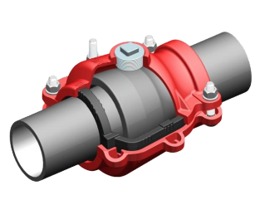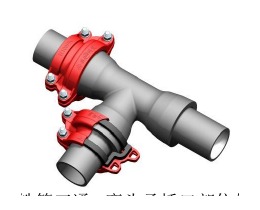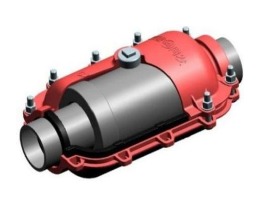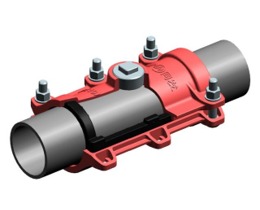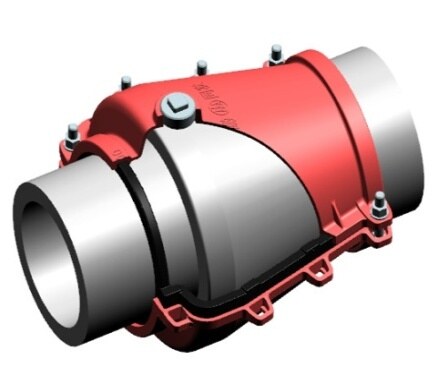
Two clamps are sitting on your procurement manager’s desk. One is 304 stainless steel from an American supplier, priced at $1,800. The other is fusion-bonded-epoxy-coated QT450-10 ductile iron from a Chinese supplier, priced at $420. Both claim corrosion resistance. Your job is to know when the price gap is justified — and when the cheaper option is genuinely interchangeable.
The two mainstream corrosion-resistant options
Stainless steel body (typically 304 or 316): the body material itself resists corrosion through the chromium-oxide passive layer. No coating required.
Coated ductile iron (QT450-10 + zinc + FBE topcoat): the body is standard QT450-10 ductile iron, but protected by a two-layer system:
- Arc-sprayed zinc — typically 200 g/m² per ISO 8179-1:2017 — provides galvanic protection (the zinc corrodes preferentially, protecting the iron underneath)
- Fusion-bonded epoxy (FBE) topcoat — typically 250–400 µm thick — provides a physical barrier against moisture and chemicals
Both approaches work in most applications. The choice comes down to environment, life expectancy, and budget.
Where stainless wins
1. Raw seawater and brackish water: Chloride ions in seawater penetrate FBE coatings over time and initiate under-coating corrosion. 316 stainless (with molybdenum addition) resists chloride pitting far better than 304 or coated DI.
2. Food-grade and potable-water service under strict regulation: Some jurisdictions require stainless body (not coated) for clamps in direct contact with drinking water. Coated DI is usually acceptable (FBE is NSF-61 certified for potable water), but some utility specs are stricter.
3. Above-ground installations exposed to UV: Epoxy coatings degrade under UV over 10–15 years. Exposed clamps (river crossings, exposed mains) benefit from stainless.
4. Soils with stray electrical currents: Near rail systems, DC-fed industrial equipment, or high-voltage transmission lines, stray currents accelerate galvanic corrosion on buried steel/iron. Stainless is less susceptible.
5. Aggressive chemical contact: Strong acids (pH <4), strong alkalis (pH >11), hypochlorite, sulfates — these degrade epoxy coatings. 316 stainless handles most, though not all.
6. 50+ year expected service life without maintenance: Coated DI may need recoating or replacement around the 25–40 year mark; stainless can go longer.
Where coated DI wins
1. Cost: Typically 3–5× cheaper for the same size. On a 100-clamp utility stockpile, this is a real number.
2. Standard municipal water distribution: pH 6.5–8.5 treated water in standard clay/loam soils is benign. Coated DI is the industry default for a reason — it works, it’s cheaper, and it’s well-supported across specifications.
3. Heavy wall strength: QT450-10 DI castings are stiffer per unit cost than thin-wall stainless. For large diameters (DN500+) where clamp bending under pressure is a real concern, coated DI is structurally superior.
4. Repairability and replacement supply: Coated DI clamps are universally available from multiple manufacturers globally. If you need DN800 in 3 days, you can source coated DI; stainless in that size may have 8+ week lead times.
5. Soil environments with moderate corrosivity: Neutral pH soil, non-chloride-contaminated groundwater — the coating stays intact for the typical 25-year+ service life. Not worth paying stainless pricing.
The decision matrix
| Environment | Recommendation |
|---|---|
| Standard municipal drinking water, pH 6.5–8.5, neutral soil | Coated DI — default choice |
| Coastal / brackish water / salt-spray exposure | Stainless 316 |
| Pure seawater immersion | Stainless 316 minimum; specify duplex for severe |
| High-pressure industrial water (2+ MPa) with corrosive additives | Stainless or coated DI with enhanced coating spec |
| Natural gas distribution (underground) | Coated DI with NBR gasket — see our NBR post |
| Industrial wastewater, neutral | Coated DI |
| Industrial wastewater with sulfides | Stainless 316 or 317 |
| Mining slurry | Stainless; rubber-lined if abrasive |
| Stray-current zones (rail, industrial) | Stainless or coated DI + cathodic protection |
Coating spec — what to actually ask for on coated DI
“Coated ductile iron” is a range, not a single spec. When buying, specify:
- Zinc layer: arc-sprayed zinc, minimum 200 g/m², per ISO 8179-1:2017
- FBE topcoat: fusion-bonded epoxy, minimum 250 µm dry film thickness, with holiday test passed at 5 kV/mm
- Cure verification: MEK rub test per ASTM D4752 for field identification of proper cure
- Adhesion: minimum 5A rating per ASTM D3359 cross-cut tape test
- Factory inspection report: per-lot coating thickness measurement (spot checks at 10+ points per clamp)
If a supplier can’t produce this documentation, the coating quality is probably marginal. Quality epoxy-coated DI is not visually distinguishable from poor-quality epoxy-coated DI — paper trail is your only defense against the latter.
Hybrid options
Some suppliers (including PipeKnot, on custom orders) offer hybrid construction:
- DI body with stainless steel bolting — the bolts are where corrosion bites first anyway. Swapping carbon-steel bolts for 316 stainless adds modest cost but eliminates the most common failure mode.
- DI body with stainless-steel gasket retainer rings — for higher-end water-distribution specs.
- DI body with coated bolts + stainless nuts — mid-priced compromise.
For most utility applications, standard coated DI with NBR or EPDM gasket is the right cost-performance point. For mission-critical or severely corrosive applications, our FCH/CR series stainless steel plate repair clamps are available in stainless.
Field inspection: how to tell if a coated clamp is healthy
On a buried clamp you’ve dug up:
- Color: fresh FBE is deep red-orange. Fading to dull brown indicates UV exposure or aging.
- Chalking: white powdery deposit on the surface is UV degradation of the epoxy. Not immediately dangerous but indicates the barrier is weakening.
- Blistering: raised bumps in the coating indicate under-coating corrosion or cathodic disbondment. Replace the clamp.
- Rust at bolt heads: expected if carbon-steel bolts were used. Not a coating failure but a bolt corrosion issue.
- Chalk-white zinc deposits along bolt lines: zinc is doing its job galvanically. Not a failure; means the coating is working.
PipeKnot’s standard corrosion packages
- Standard: QT450-10 DI + 200 g/m² arc-sprayed zinc + 250 µm FBE. Rated for 25+ year buried service in neutral soil / potable water.
- Enhanced: as standard but 400 µm FBE + stainless 316 bolting. Rated for brackish coastal service, mildly aggressive soils.
- Premium: 316 stainless steel band body (FCH/CR series) + EPDM/NBR gasket. For seawater, chemical service, or 50+ year specs.
Tell us the environment, the service life you want, and the specific chemistry (if unusual), and we’ll recommend the right package. Upgrading from standard to enhanced is typically a 20–30% cost premium; premium is roughly 4–6× standard pricing.
Further reading
- QT450-10 ductile iron explained
- Why NBR (not EPDM) for gas lines
- Pipe repair clamp standards compared
Sources
- ISO 8179-1:2017 — Ductile iron external zinc-based coating
- U.S. Pipe — Metallic Zinc Coating for Ductile Iron Pipe — coating spec overview
- American Cast Iron Pipe — Zinc Coating — dual-layer protection rationale
- McWane Ductile — Bonded coatings overview